
What does HELM notation actually solve, and why has it become essential to modern drug discovery?
What HELM Is?
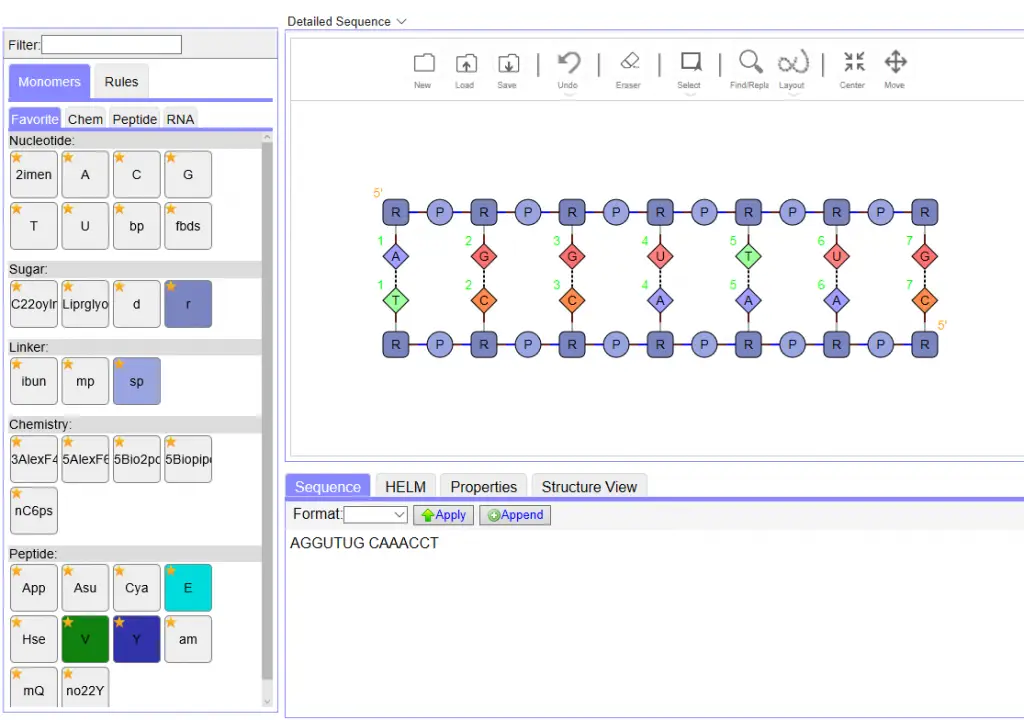
HELM stands for Hierarchical Editing Language for Macromolecules. It is the industry-standard notation developed to accurately represent complex macromolecules including oligonucleotides, peptides and drug conjugates. Where a small molecule can be represented reasonably well with standard chemical notation, macromolecules require a system built specifically to capture their structure, sequence information, and connectivity that standard cheminformatics tools were not designed to handle.
HELM was originally developed by Pfizer and later released as an open standard, now maintained by the Pistoia Alliance, precisely because the industry needed a shared way to represent molecules that don’t fit neatly into small-molecule notation systems like SMILES or InChI.
Why Standard Chemical Notation Falls Short?
Standard chemical notation formats were built for small molecules, defined, discrete structures with a relatively small number of atoms and bonds. A macromolecule, by contrast, might be a peptide with unnational amino acids conjugated with an oligonucleotide with unnatural nucleotides by a chemical linker. Such a macromolecule could have hundreds to thousands of atoms and bonds with enhanced stereochemistry. An antibody-drug conjugate adds another layer entirely: an antibody, a linker, and a payload, each with their own structure, connected in a specific and often variable way.
A registration system without native HELM support can register a small molecule effectively. It falls short the moment the pipeline touches a more complex modality, because there is no accurate way to represent a complex macromolecule within the system’s underlying data model. The common workaround is a flat text field, an attached document, or a completely separate system, none of which are searchable, comparable, or reliable the way a native HELM-supported entity record is.
Why This Gap Often Goes Unnoticed Until It’s Urgent?
For an organization built around a defined small molecule program, this limitation is often invisible. The registration system works. Nothing about the current pipeline requires HELM support, so the absence of it doesn’t register as a gap.
It becomes urgent the moment a pipeline decision changes direction. That might be a licensing opportunity for a macromolecule asset, a strategic pivot toward ADCs, or the natural evolution of a research program into a new modality. By the time that moment arrives, the registration system is either ready or it isn’t, and there is rarely time to build genuine HELM support into an existing platform mid-stride.
What Native HELM Support Actually Enables?
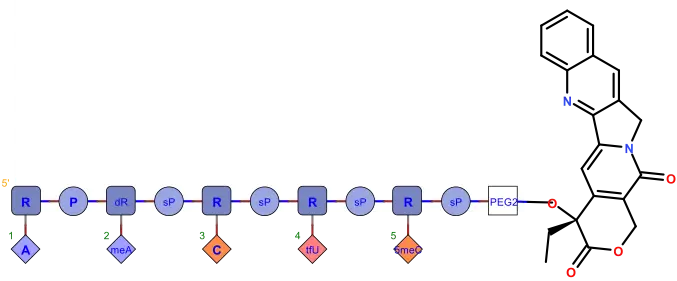
A registration system with true HELM support allows structure, substructure, and sequence search across all drug modalities in the same way small-molecule search already works for simpler compounds. It allows accurate representation of ADC conjugates, including payload, linker, and antibody component relationships, each tracked independently but connected within a single entity record. It means the registration record itself is the source of truth for structure and sequence, not a workaround stored somewhere else, in a document, a spreadsheet, or a colleague’s memory.
Practically, this changes what a scientist can actually do day to day. A structure search returns results across the full registered library, not just the small-molecule subset. An assay result stays connected to the exact conjugate it was run against, down to the specific payload and linker combination. A drug discovery program that starts small can scale without the organization needing to rebuild its registration infrastructure from scratch.
Why This Matters Regardless of Where Your Pipeline Is Today?
Even organizations working exclusively with small molecules today benefit from choosing infrastructure that doesn’t box them in. Drug discovery pipelines rarely stay static. A small molecule or antibody program can be expanded into a new drug modality such as ADCs or DACs. When that happens, a registration system without genuine HELM support becomes the constraint on the new direction, exactly when the organization can least afford a system migration. Scilligence’s RegMol was built with HELM support as a core capability, not an add-on, by the same team behind the HELM Web Editor. Whether an organization is registering its first small molecule or its first ADC three years from now, the system is ready either way.
