
A robot is only as useful as the data behind it. When samples, instruments and records live in separate systems, a robot can move a bottle, but it cannot say where the bottle went, why it moved, or what it contained.
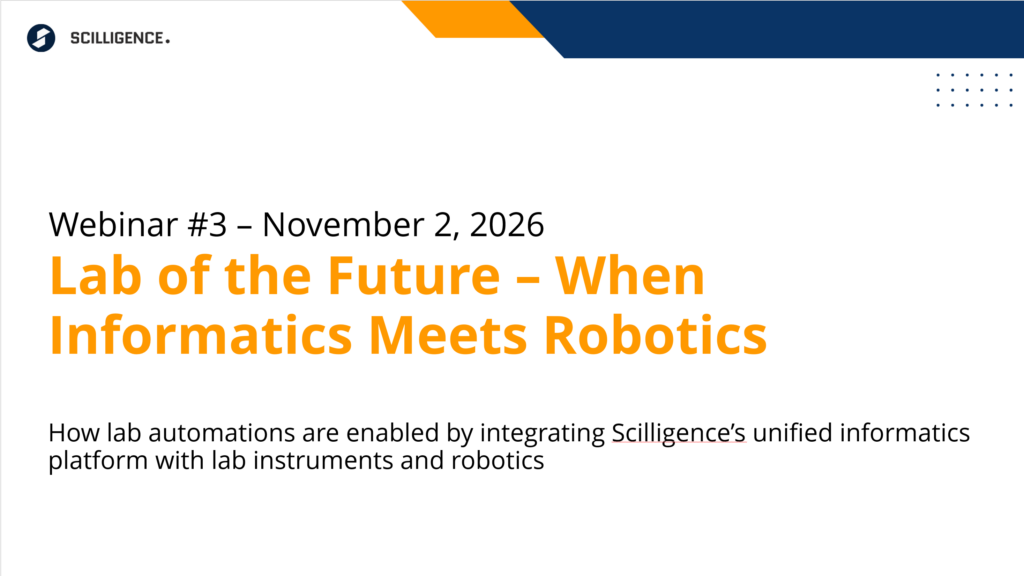
That was the focus of Part 3, the final webinar in our Fall series, held on November 2026. Jinbo Lee, co-founder and CEO of Scilligence, and Kepin Li, CEO of HintonAI, showed how lab instruments, a unified informatics platform and AI-driven robots can work as one system.
Where software meets hardware
Most drug discovery data starts in a laboratory instrument, so software alone cannot make research more efficient. Scilligence has spent years connecting its platform to instruments and equipment, whether they use serial ports, web services such as Empower, or industrial protocols such as OPC and TCP/IP. For standalone instruments with no web service, our data crawler pulls files in automatically and extracts the metadata.
That data lands in Scilligence SDMS, where it is version controlled and secured, and then appears directly in the electronic lab notebook or RegMol. No copying from a USB drive, and no manual upload.
From walk islands to mobile robots
In many labs, each instrument sits on its own “walk island,” and moving samples between them still takes a technician. Autonomous mobile robots can travel around the lab, and even between buildings, which brings automation to steps that could not be automated before, with real-time traceability, easier GxP compliance and safer handling of potent or radioactive materials.
Kepin explained HintonAI’s model-driven approach. Instead of programming every movement by hand, the robot works “the human way,” combining small atomic skills such as navigating, scanning a barcode, picking a bottle and placing it in a rack. Because skills can be reused, the same robot can switch tasks or adapt when a lab changes.
Five workflows, shown live
The demonstrations ran on Scilligence Inventory, which tracks the full life cycle of a drug substance in R&D. Scilligence Inventory creates a task, sends it to the robot through the HintonAI API, and updates automatically when the robot finishes. The five workflows shown were:
- Sample receiving
- Sample requisition
- Sample return
- Waste disposal
- Inventory audit
Kepin was candid that accuracy is not yet 100% and that each skill keeps improving with more training. His view on the business case: “There’s no way to just use the robot for the purpose of using it. It’s the cost, the effectiveness and the efficiency that is driving us to deploy the right robot technology.”
The session closed with a lively Q&A. Attendees asked about opening shelf drawers, choosing between a mobile robot and a fixed arm, reconnecting older serial-port instruments, handling missing bottles, and where to start. The short answer on starting: begin small. The platform is modular, and most biotechs begin with RegMol and the electronic lab notebook, then add Inventory when they are ready.
Watch the Part 1 replay and register for Part 3
Missed Part 1, AI-Powered Informatics Platform for All Drug Modalities Part One?
The replay is available here: AI Powered Informatics Platform for all Drug Modalities Part One
Missed Part 2, AI-Powered Informatics Platform for All Drug Modalities Part Two? The replay is available here: AI Powered Informatics Platform for all Drug Modalities Part Two
If you’d like to see how a model could connect to your own data, let’s get started:
Book a DEMO Here
Want to see it in action? Fill out the form below to get access to the full webinar replay instantly.
Replay is also available with:
The Scilligence Team
